Scientists built tiny robots that can collect bacteria using light
Scientists created light-powered nanorobots smaller than a bacterium that can collect, transport and release bacteria in controlled laboratory experiments.
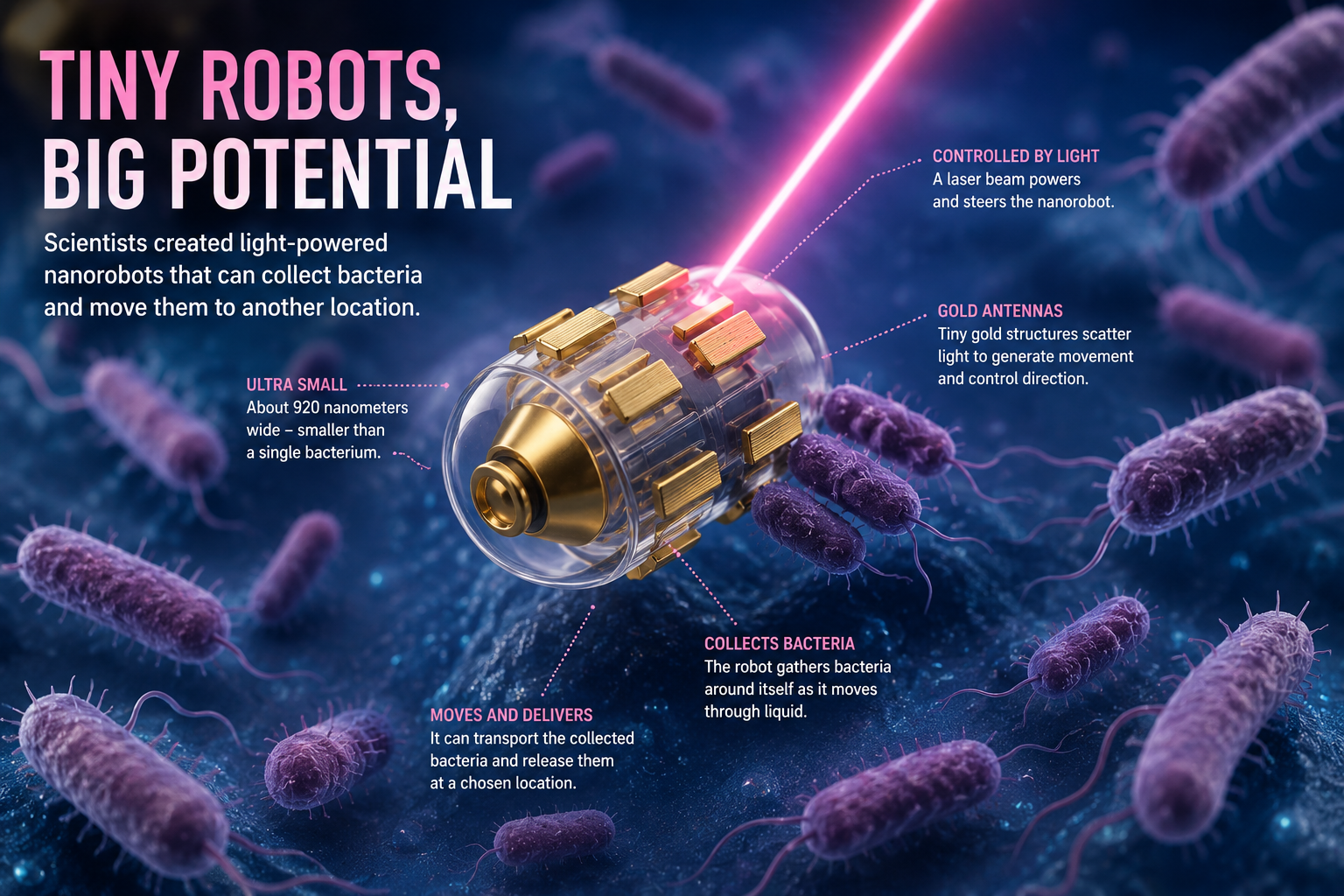
Scientists have developed robots smaller than a single micrometer that can be guided through liquid using light. In laboratory experiments, the tiny machines were able to move toward bacteria, collect them, transport them to another location and release them again.
The reason researchers are developing machines at this scale goes much further than simply making robots smaller. Scientists want tools that can operate directly in the microscopic environment of bacteria, cells and other biological material. Ordinary instruments are far too large to move through that world and precisely manipulate individual microscopic objects.
A controllable nanorobot could provide another way to do that. Instead of remaining outside a biological sample and manipulating something from a distance, the robot itself can travel to a specific microscopic location. Researchers could potentially use this ability to manipulate biological material, perform highly localized sensing or transport substances to a particular place.
Targeted drug delivery is one of the possible future applications identified by the researchers. A microscopic carrier that can be guided toward a specific location could eventually offer a way to deliver a substance exactly where it is needed. That has not been demonstrated in patients, and the robots in this research are not currently being used to treat infections or deliver medication inside the human body.
What researchers have already demonstrated is the basic ability required for such precise microscopic work: they can control where the robot goes, use it to interact with biological material and make it carry that material somewhere else.
And they can do all of this with light.
What exactly did the scientists create?
Researchers at Julius-Maximilians-Universität Würzburg in Germany developed the nanorobot as part of their work on extremely small light-controlled machines.
The new robot measures approximately 920 nanometers in diameter and weighs only about 0.26 picograms.
A nanometer is one millionth of a millimeter. To put its size into something easier to picture, a human hair is roughly 50 times wider than this nanorobot.
At that scale, building a robot works very differently from building the machines we normally associate with robotics. There is no room for a conventional battery, electric motor, wheels or mechanical steering system.
The researchers therefore use an external source of energy: laser light.
Inside the robot are carefully arranged gold nanostructures. These structures act as tiny antennas that interact with incoming light. Their design allows the researchers to turn the momentum carried by light into the force needed to propel the robot.
This gives the robot a way to move without carrying its own conventional power supply.
How can light make a robot move?
Light does not feel as though it can push anything, but it carries momentum.
When light interacts with an object and changes direction, a tiny amount of momentum is transferred. For something as large as a person or a car, the resulting force would be insignificant. For an object weighing only a fraction of a picogram, it can become useful.
The gold structures inside the nanorobot are designed so that they scatter incoming light unevenly. More light is directed one way than another, creating a small force in the opposite direction.
That force pushes the robot through the liquid.
The researchers used laser light with a wavelength of 980 nanometers to power the system. The laser remains outside the robot, which means the tiny machine does not have to carry the equipment producing its energy.
Making a nanorobot move forward is only one part of the challenge, however. Researchers also need to determine where it goes.
At this scale, that is particularly difficult.
How do you steer something smaller than a bacterium?
A nanorobot suspended in liquid does not sit quietly waiting for someone to tell it where to go.
The molecules surrounding it are constantly moving and colliding with it. These countless tiny collisions produce random movement known as Brownian motion.
Brownian motion exists around larger objects too, but its effect becomes much more important as objects become extremely small. A nanorobot can constantly be knocked away from its intended orientation by molecular movement.
The researchers therefore needed a way to both propel the robot and keep it facing the correct direction.
They again use light to accomplish this.
Light waves can have a particular orientation, known as polarization. The nanostructures inside the robot respond to that orientation and cause the robot to align itself with the polarization of the incoming light.
When researchers change the polarization, they can change the robot's orientation.
The robot can then move in the new direction.
For more deliberate turns, the team briefly used circularly polarized light. This enabled controlled 90-degree changes in direction.
Researchers demonstrated this steering ability by guiding robots along predetermined routes. They made them travel around rectangular paths, through a rectangular spiral and along routes forming the characters “EP5.”
These experiments showed that the robot was not simply being pushed randomly by a laser. Its direction could repeatedly be selected and changed.
That ability is essential to its purpose. A microscopic carrier is only useful for targeted work if researchers can decide where it goes.
Why does precise steering matter?
Imagine a laboratory sample containing thousands or millions of microscopic objects. Simply having a nanorobot moving somewhere inside that sample would offer limited control.
Researchers want to be able to send such a machine toward a selected location.
That is particularly relevant when working with biological material. Cells, bacteria and other structures can be only a few micrometers across. Researchers often need to study or manipulate very small areas without disturbing everything around them.
A controllable nanorobot creates the possibility of bringing the tool to the target rather than moving or manipulating the entire surrounding environment.
The Würzburg researchers demonstrated that idea using bacteria.
They did not simply steer their robots around an empty container. They placed them in liquid containing bacteria and investigated whether the robots could physically interact with the biological material around them.
How does the nanorobot collect bacteria?
The researchers tested the robots with two types of bacteria: Escherichia coli, commonly known as E. coli, and Staphylococcus carnosus.
Once the nanorobot was illuminated, something happened around it in addition to propulsion.
The interaction with the laser created a very small temperature difference in the surrounding liquid. Tiny particles and biological material can move in response to temperature differences, a phenomenon known as thermophoresis.
In this experiment, the resulting forces helped attract nearby bacteria toward the nanorobot.
The robot therefore did not need a mechanical arm, container or grabbing device to pick up bacteria individually. Bacteria approaching the area around the illuminated robot could gather around it and form a cluster.
As the robot moved through the bacterial suspension, that cluster could continue to grow.
This gave the researchers a microscopic moving collection point.
Instead of manipulating one bacterium at a time, they could guide the robot through an area and gather multiple bacteria around it.
Why do the researchers call it a nanoscale robotic cleaner?
The name refers directly to what the robot was able to do during the experiments.
Researchers could steer it through a selected area containing bacteria. As it moved, bacteria accumulated around the robot. The loaded robot could then be directed away from that area, taking the collected bacteria with it.
In other words, it could remove bacteria from one microscopic region and transport them somewhere else.
The bacteria were not being killed or destroyed. The robot was collecting and relocating them.
That distinction is important because the technology is being developed as a way of manipulating microscopic material rather than simply eliminating it.
The nanorobot also remained controllable after bacteria had accumulated around it.
The additional weight slowed its movement, but researchers found that it could continue to move and respond to changes in the light. According to the study, the robots could transport bacterial loads hundreds of times heavier than their own weight.
For a machine weighing only about 0.26 picograms, even a microscopic cluster represents a substantial load.
Can the robot release what it collects?
Transporting biological material would be far less useful if everything remained permanently stuck to the robot.
The researchers therefore also tested whether the process could be reversed.
When the laser was switched off, the forces holding the bacteria around the nanorobot disappeared. The collected bacteria then began to disperse.
Researchers could therefore use the robot to complete a sequence: collect bacteria, move them through the liquid and release them at another location.
This ability helps explain why the research extends beyond the idea of cleaning bacteria from a surface.
A controllable carrier that can pick up microscopic material and release it somewhere else could become useful anywhere scientists need to manipulate biological material at a very small scale.
Why not simply use existing microscopic tools?
Scientists already use light to manipulate extremely small objects.
One established technique is called optical tweezers. A tightly focused laser beam can create forces capable of trapping and moving microscopic particles, including cells and bacteria.
The nanorobot approaches the problem differently.
Rather than using the laser itself as the object that directly traps and moves each bacterium, researchers use light to control a physical microscopic robot. That robot can travel through the liquid and collect multiple bacteria around itself.
The study reports that the laser intensity used for bacterial manipulation with the nanorobot was around two orders of magnitude lower than the intensity required for conventional optical trapping of bacteria.
Researchers also measured the local heating produced during operation. The temperature increase remained below 10 kelvin.
Controlling light exposure and heating is important when researchers are working with biological material, which can be affected by excessive energy or temperature changes.
What could these robots eventually be used for?
The current study establishes a method for moving and controlling a robot at approximately the same scale as the biological material scientists may want to investigate.
The researchers identify biological manipulation and bioengineering as possible areas for further development. A controllable nanorobot could provide a way to collect, arrange or transport microscopic biological material inside a sample.
Another possible use is localized sensing.
Instead of measuring conditions across an entire sample, a microscopic machine could potentially be guided toward a specific location where scientists want information.
Targeted drug delivery is also mentioned as a possible future direction.
The principle is based on location. Many substances introduced into a biological system spread beyond the exact area researchers or doctors may want to reach. A microscopic carrier that can be actively guided could potentially transport a substance toward a more precise target.
The current nanorobots have not been demonstrated delivering medication inside a human body, and the study does not show them treating disease. Targeted drug delivery remains a possible future application of the technology rather than an existing medical use.
The bacterial experiments answer an earlier and more fundamental question: can researchers build something this small, control where it goes and make it carry biological material?
Their experiments show that they can.
Could several nanorobots work at the same time?
The experiments demonstrate control of individual microscopic robots, but the researchers also discuss how the technology could eventually be expanded.
One possibility would be to divide an illumination source into several separately controlled light fields. Each field could then potentially steer its own robot.
That could allow groups of microscopic robots to perform tasks in parallel rather than relying on a single machine.
The researchers have not yet demonstrated a working swarm performing biological tasks together. They describe technical challenges that would have to be solved, including providing enough laser power and maintaining precise optical control over multiple robots.
It remains a direction for future research.
What has actually been demonstrated?
There is an important difference between what these nanorobots can already do and what researchers hope the technology may eventually make possible.
The demonstrated technology works in a controlled laboratory environment.
Scientists have built nanorobots approximately 920 nanometers across and shown that laser light can propel them through liquid. They can control their orientation, make them turn and guide them along selected paths.
The robots have reached speeds of up to 50 micrometers per second.
Researchers have also placed them among bacteria and demonstrated that they can collect both E. coli and Staphylococcus carnosus. The resulting bacterial clusters can be transported while the robot remains maneuverable.
Switching off the laser allows the collected bacteria to disperse again.
The robots are not currently medical treatments. They have not been demonstrated traveling through a patient's body, removing an infection or delivering medication to a human organ.
The reason the research matters to scientists is more fundamental: it demonstrates that a controllable artificial machine can operate at roughly the same microscopic scale as bacteria and physically interact with biological material.
That gives researchers a new type of tool to develop.
A machine smaller than a micrometer can now be given energy from outside, steered using light, sent toward biological material, used to collect that material and directed somewhere else before releasing it again.
For researchers trying to work inside a world too small for ordinary instruments, that is exactly the capability they wanted to test.