Meta Ray-Ban Gen 2 Wayfarer: smart glasses that finally understand technology can look good too
Discover how Meta Ray-Ban Gen 2 Wayfarer smart glasses fit into everyday life with AI, camera, live translation, audio and hands-free features.

Smart glasses can easily sound like something you wear mainly to show the world how many gadgets you own. The Meta Ray-Ban Gen 2 Wayfarer changes that impression pretty quickly. At first glance, you mostly see a black pair of Ray-Ban Wayfarers. There is no screen floating in front of your eyes, no futuristic headset wrapped around your face, and nothing about the design makes you look like you are heading to a tech convention.
That is actually a big part of the appeal.
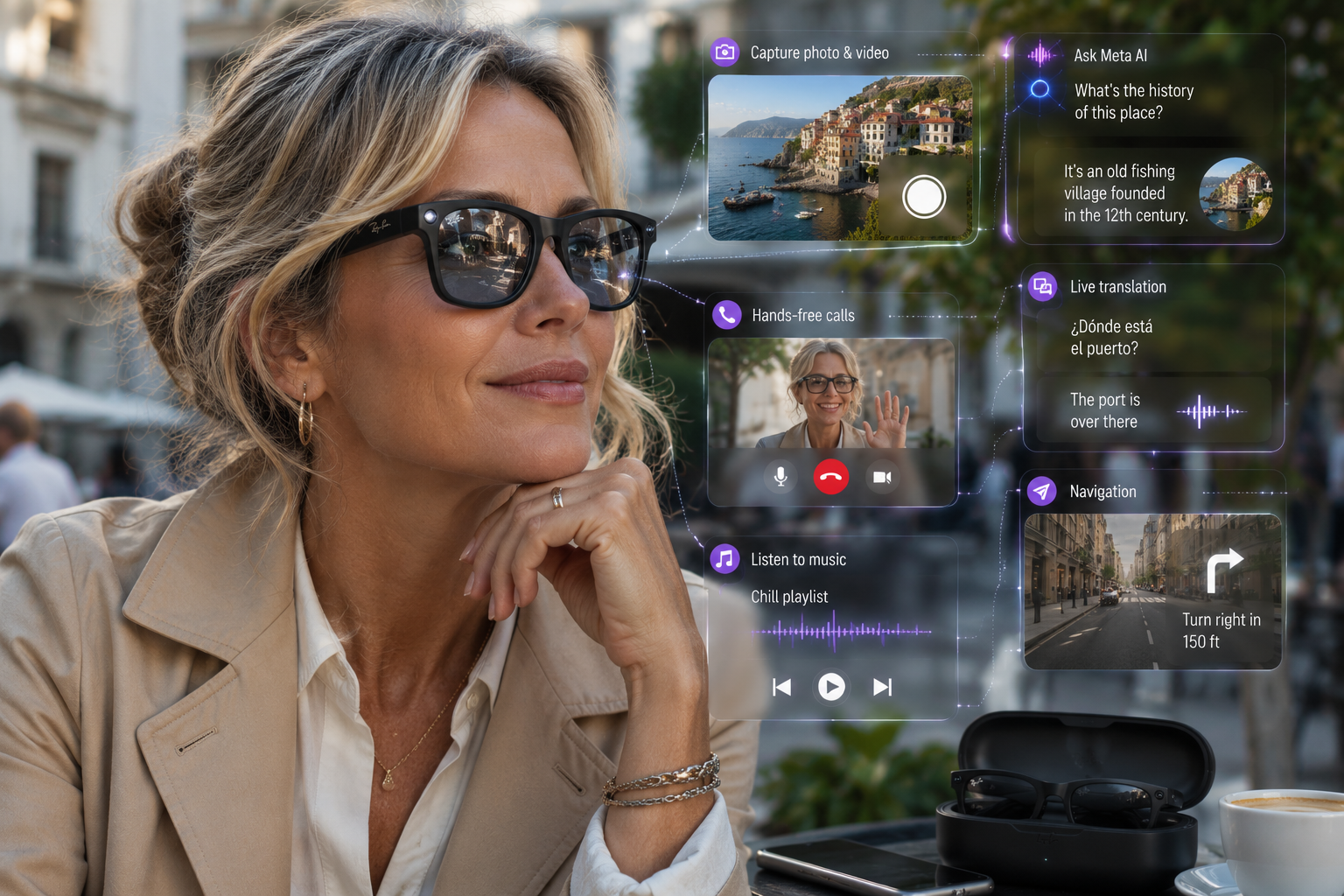
The Matte Black version with Clear Lenses looks like a pair of glasses you could genuinely wear every day. Hidden inside the frame are a camera, speakers, microphones and Meta AI. You can take photos and videos, listen to music, make calls, ask AI questions and hear translations without constantly reaching for your phone.
That sounds impressive on paper, but a long list of specifications still does not explain why you, as a woman, would want to spend hundreds of dollars on smart glasses. The more interesting question is what they could actually change when you wear them in real life.
You don't have to reach for your phone every time something beautiful happens
There is something strange about the way our phones have become part of almost every memorable moment. You see something you want to keep, reach for your phone, open the camera and suddenly you are looking at that same moment through a little screen.
You captured it, but for a few seconds you also stepped outside of it.
The camera inside the Meta Ray-Ban is designed to make that experience feel different.
The glasses have a 12 MP ultra-wide camera that can take photos and record hands-free video. The Gen 2 can record video at up to 3K resolution, with clips of up to three minutes.
That becomes especially useful during moments when you would rather keep your hands free.
You could be walking through New York when something catches your eye. Maybe you are exploring a market on vacation where everything around you is happening at once. Your dog suddenly does something hilarious that will absolutely never happen again once you finally find your phone. Your child is running ahead of you. You are cycling, cooking, carrying shopping bags or simply enjoying a place you have never seen before.
With a voice command, you can ask the glasses to take a photo or start recording.
The difference sounds small until you think about the experience. The camera records from roughly your own point of view, so instead of documenting the moment as someone standing outside of it, you can capture something much closer to the way you actually saw it.
For travel, this might be one of the most appealing features.
Think about how many vacation photos involve exactly the same routine: stop walking, find your phone, open the camera, take the picture, check the result, put the phone away and continue.
With smart glasses, you can keep looking around while capturing what you see.
That does not mean your smartphone camera suddenly becomes unnecessary. If you want carefully composed photos, zoom, detailed camera controls or complete control over the framing, your phone is still the better tool.
The glasses are much more about spontaneity.
For a broader view of where these assistants fit, continue with the Pink Dramatic guide to AI, privacy and human judgment.
Meta AI is connected to what you are actually looking at
This is where the Meta Ray-Ban becomes much more interesting than simply being a Ray-Ban with a camera hidden inside.
Meta AI can work with what you are seeing through the glasses. You can look at a landmark and ask what it is, get help understanding something in front of you, hear translations or ask for information without first unlocking your phone and typing a search query.
That gives AI a very different place in everyday life.
Imagine standing in front of a building you do not recognize. Normally, you would take out your phone, figure out exactly what to search for and potentially end up five minutes deep in Google when all you originally wanted to know was the name of the building.
With the glasses, you can simply ask about what you are looking at.
Shopping creates another interesting use case. If you see something and are not quite sure what it is, you can ask about it. Meta also promotes visual AI features that can help you interact with and understand things around you.
Suddenly, AI feels a little less like a chatbot waiting behind an app icon and a little more like an assistant that is available while you are actually living your day.
Not every AI feature will be equally useful to every woman, and availability can vary depending on your country, language and software version. These glasses should not be bought with the expectation that Meta AI will magically solve everything for you.
The value is much more subtle.
It is about those little moments when you would normally reach for your phone.
And those little moments add up surprisingly quickly during a day.
For another look at technology designed around travel and listening, read how Apple AirPods Max 2 Purple adapt to journeys, calls and changing surroundings.
Traveling is where these glasses start making a lot of sense
Live translation is one of the features that makes the idea of smart glasses much easier to understand.
The glasses support live translation for multiple languages, although language availability continues to depend on Meta's supported regions and software. The glasses need to be paired with a compatible smartphone and the Meta AI app for their connected features.
The interesting part is that you do not necessarily have to stand in front of someone while holding a translation app between the two of you.
That changes the experience of a conversation.
When someone is speaking to you and you keep looking down at your phone to understand them, that device becomes a physical barrier between you. If you can hear translated speech through your glasses, you can continue looking at the person in front of you.
For women who travel regularly, especially those who enjoy exploring cities on foot, there is another practical advantage. Several functions remain accessible without having your phone visibly in your hand all the time.
You can listen, make calls, ask for information and use certain voice functions while your phone stays in your bag.
That does not turn the Meta Ray-Ban into a safety device, and it should not be treated as one. The practical advantage is much simpler: your hands remain free and your attention does not have to return to a screen every few minutes.
If music matters more than open-ear convenience, the Beats Solo 4 Metallic Pink guide explains a lighter, dedicated headphone option.
Listening to music without completely shutting out the world
The Wayfarer has open-ear speakers built into the arms of the frame, together with a multi-microphone system.
Open-ear audio means you do not have to put earbuds into your ears to listen to music, podcasts, directions or phone calls.
That can be surprisingly convenient when you are walking through a city, taking the dog out, doing things around the house or traveling somewhere unfamiliar and still want to hear what is happening around you.
You are less isolated from your surroundings than you can be with traditional headphones or noise-canceling earbuds.
There is also a very ordinary advantage here that rarely makes it into flashy technology advertising. Earbuds are another thing you have to remember, charge, put in, take out and somehow avoid losing at the bottom of your bag.
When the speakers are already inside the glasses you are wearing, one more separate device disappears from your routine.
There is an obvious compromise. Open-ear speakers are not going to give you the same immersive experience as a good pair of over-ear headphones. If your favorite way to listen to music involves completely disappearing into it, these glasses are not going to replace your headphones.
The audio becomes useful because it is simply there whenever you need it.
Your phone can stay in your bag during a call
Hands-free calling hardly sounds revolutionary anymore, until you think about how many times your hands are actually occupied during the day.
You might be walking, cooking, cleaning, carrying groceries or rushing through an airport when someone calls.
The built-in microphones can pick up your voice while the speakers let you hear the person you are talking to. Voice controls can also be used for supported messaging and communication features.
Again, there is no single spectacular feature responsible for making this useful.
It is the disappearance of the same repetitive action: finding your phone, taking it out, unlocking it and then figuring out where to put it again.
Technology is usually sold to us with the promise that we will be able to do more.
With these glasses, I find the opposite idea much more interesting: there are certain things for which you might need to handle your phone less.
Gen 2 improves one of the biggest problems with smart glasses
Smart glasses can have every clever feature imaginable, but if the battery dies halfway through the afternoon, you are eventually left wearing a very expensive ordinary pair of glasses.
That makes the improved battery life of the second generation much more important than it might initially sound.
Meta gives the Gen 2 up to eight hours of battery life with typical use. Actual battery life naturally depends on what you are doing. Recording video, using audio features and regularly interacting with AI will consume more power than simply wearing the glasses.
The charging case makes the idea of wearing them throughout the day more realistic because you can recharge them when you are not using them instead of having to find a cable every time the battery runs low.
Eight hours does not mean you can continuously film, make calls and use AI for eight hours straight. Real-world battery life will always depend on your usage.
It does, however, make the second generation much more believable as something you could wear for a significant part of your day rather than a gadget that needs constant attention.
Thankfully, they still look like Ray-Bans
Maybe appearance sounds superficial when we are talking about AI, cameras and smart technology, but anything sitting directly in the middle of your face has to look good enough for you to actually want to wear it.
You can put incredible technology inside a pair of glasses, but if you hate the way they look on you, they are going to stay at home.
This version uses the familiar square Wayfarer design with a Matte Black frame and Clear Lenses.
From a distance, someone does not necessarily immediately see that you are wearing smart glasses.
That is much more appealing to me than technology that constantly demands attention for itself. Glasses become part of your face and your outfit in a way most gadgets never do. Your phone disappears into your handbag. A smartwatch can hide underneath a sleeve. Glasses immediately influence the way you look.
Ray-Ban has an advantage here that many technology companies cannot simply recreate.
The Wayfarer was already an iconic fashion design long before anyone started talking about putting AI into glasses.
If you want to see the exact version discussed here, the Meta Ray-Ban Gen 2 Wayfarer in Matte Black with Clear Lenses is available on Amazon, so you can check the current price, specifications and availability yourself.
There is a privacy question you should not ignore
A camera sitting on your face is different from a camera inside your phone.
When you lift your phone to film someone, it is usually fairly obvious what you are doing. With a camera built into a pair of glasses, that distinction becomes less obvious.
The Meta Ray-Ban includes a visible capture LED designed to indicate when the camera is being used, but as the person wearing the glasses, you are still responsible for how and where you use that camera.
That matters.
In public spaces, the ability to capture spontaneous footage can be wonderful, but not everyone is comfortable being filmed. In private settings, workplaces and personal conversations, that becomes even more important.
Technology making something possible does not automatically mean every possible use of it will feel comfortable to the people around you.
You should also remember that these glasses are part of a larger connected ecosystem. Many of the smart features depend on your smartphone, the Meta AI app, an internet connection and Meta's services.
You are not buying a completely independent AI device.
The $379 question: would you actually use them?
At the time this model was checked, the Meta Ray-Ban Gen 2 Wayfarer in Matte Black with Clear Lenses was listed at $379. Amazon prices can change, so the current product page is always the better place to check before buying.
That is a lot of money if you think of them purely as a pair of glasses.
But that is not really what you are buying.
Inside the frame, Ray-Ban and Meta have combined a recognizable pair of Wayfarers with a camera, open-ear audio, microphones, hands-free communication and access to an AI assistant.
Whether $379 starts to make sense depends almost entirely on how many of those functions would become part of your everyday life.
If you rarely take photos or videos, never use voice assistants, prefer earbuds and have absolutely no problem pulling your phone out for everything, these could end up being a very expensive pair of Wayfarers.
If you travel frequently, walk a lot, create content, listen to podcasts or music throughout the day, love capturing spontaneous moments or are genuinely interested in AI moving beyond the smartphone screen, the calculation becomes very different.
For content creation in particular, the glasses have an interesting advantage. You can record from your own perspective without walking around with a phone held in front of your face. A city walk, shopping trip, festival, vacation or completely ordinary afternoon can suddenly be captured in a much more natural way.
Who are the Meta Ray-Ban Gen 2 Wayfarers really for?
I do not think these glasses are most interesting for the woman who simply wants the newest gadget because it happens to be new.
I see them making much more sense for a woman who enjoys technology but does not necessarily want to look like she is wearing technology. Someone who travels and would rather look around than constantly switch between Google Maps, a camera and a translation app. Someone who loves taking photos and videos but also wants to remain part of the moment she is capturing.
Perhaps they make the most sense for women who have started noticing just how often their phone quietly positions itself between them and the rest of the world.
That is ultimately the strange and fascinating thing about these AI glasses.
You are putting more technology on your face in the hope that you might spend a little less time holding technology in your hand.
That is where I think the real appeal of the Meta Ray-Ban Gen 2 Wayfarer begins.
You can keep walking while you capture something you see. You can continue looking at someone while trying to understand another language. You can look around while traveling instead of constantly looking down at a screen. You can capture a spontaneous moment without first searching through your bag.
The smartest feature of these glasses might ultimately be the simplest one: your phone gets to stay where it belongs a little more often, while you keep your eyes on everything happening around you.