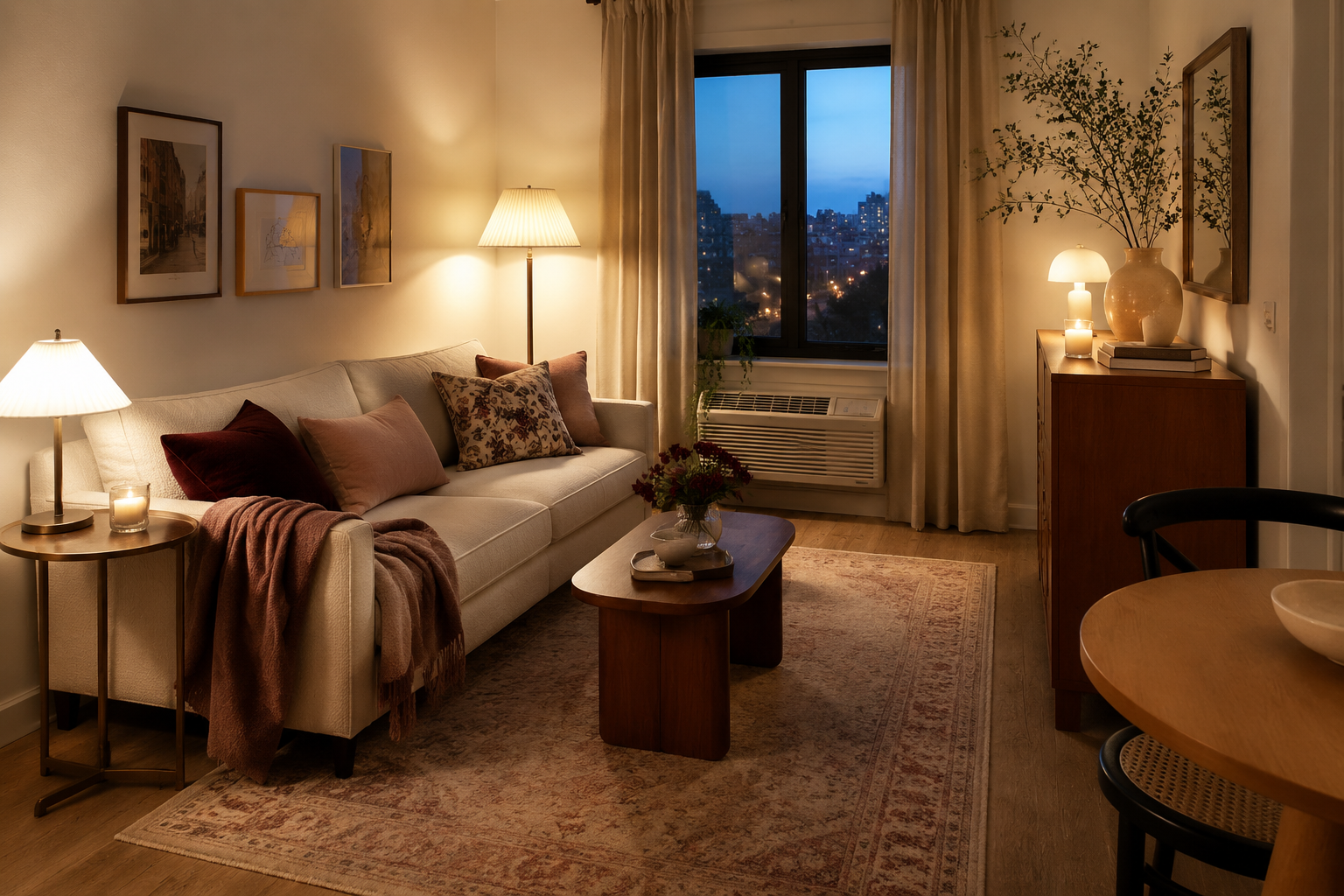

A small apartment can make you feel as though every choice has to be practical. The sofa has to fit. The table has to fold. The storage has to hide something. Yet a home cannot live on sensible decisions alone. You deserve a room that holds your life and still gives something back when you walk through the door.
Pinterest’s current USA signal for Apartment Rooms shows Pin saves up 300% compared with last month. That sudden interest makes sense. People are not simply searching for ways to squeeze another basket beneath the bed. They want a small space to feel like a sanctuary: warm, personal, calm and possible on a real budget.
The lovely part is that coziness is not measured in feet. It comes from what a room allows you to do and how it makes you feel while you are doing it. A lamp beside the chair where you actually read matters more than five decorative objects without a purpose. A clear path from the door to the window can make the whole room breathe. One beautiful color repeated with restraint can make a rental feel intentional.
Your apartment does not have to be large before it is worthy of beauty, softness and a little drama.
Begin with the life in the room, not the look
Before moving furniture, think about the moment that currently feels awkward. Do you balance dinner on your lap because the coffee table is too low? Is the only reading light on the other side of the room? Does your workday remain visible from bed? The best makeover begins by solving one irritation you experience every day.
Choose the room’s main promise. Perhaps the living room should be the place where you exhale after work. Maybe the bedroom needs to feel quiet enough for sleep, or one overlooked corner needs to become a desk that does not take over your evening. When that promise is clear, every object has a reason to stay or go.
Soft enough to settle in, deep enough to feel grown
Cream keeps the background calm. Dusty blush brings warmth close to the body. Burgundy adds the confidence that prevents pink from becoming sugary. Warm wood and brass make the whole room feel collected rather than matched.
Let one color lead, then give it space
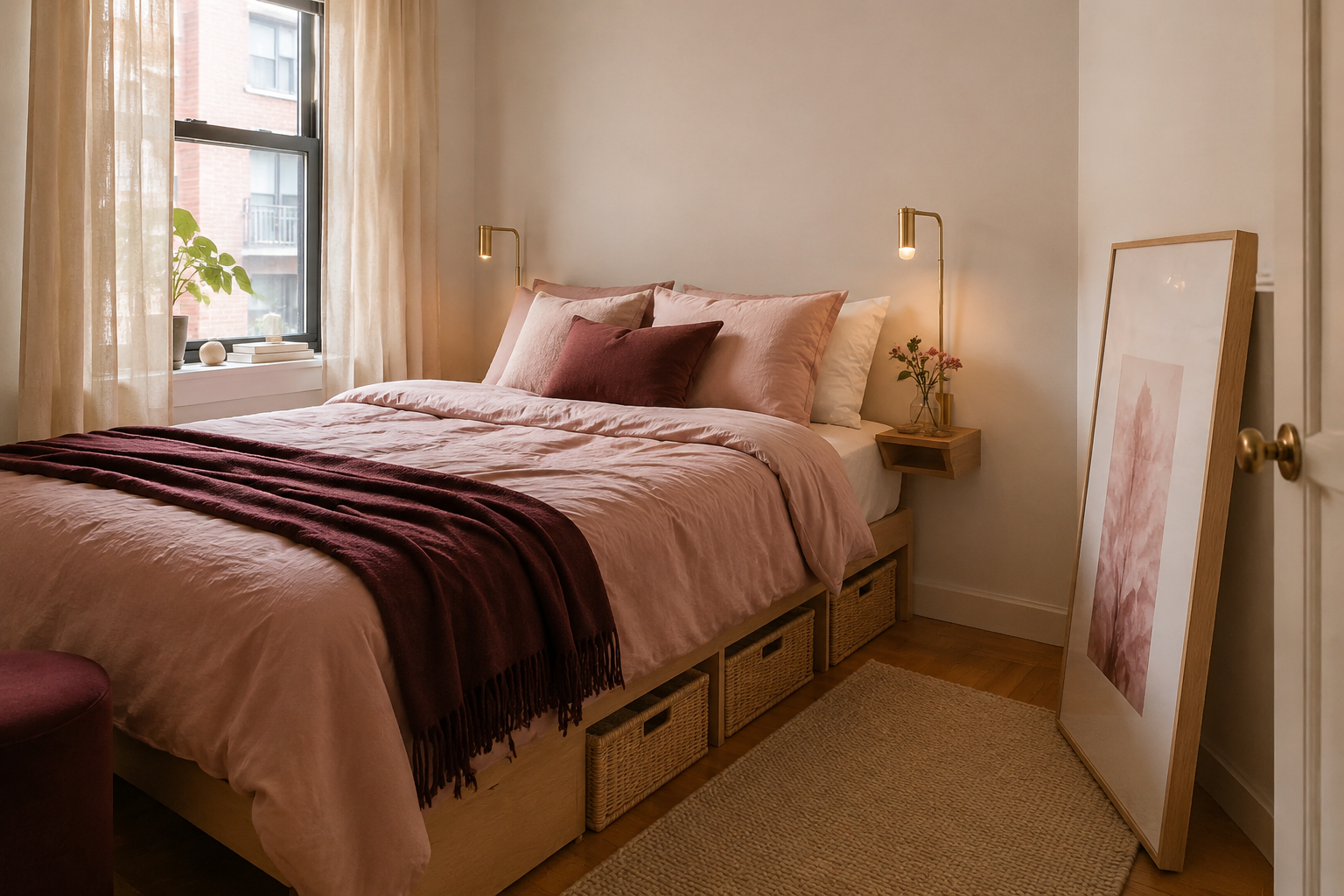
When a room is small, using more tiny things does not make the choices feel smaller. It often creates visual noise. Try one generous blush element instead: a throw folded across the sofa, curtains that fall to the floor or bedding with enough presence to lead the room. Repeat the shade once or twice in quieter details, then stop.
Deeper colors are useful because they give the eye somewhere to land. A burgundy pillow, dark rose lampshade or framed print can anchor all the paler tones. If painting is allowed, you do not need to coat every wall. A small entry, shallow alcove or the wall behind a bed can hold a richer shade beautifully. If painting is not allowed, textiles and art can create the same rhythm without touching the lease.
Protect the path through the room
A small space feels crowded fastest when you have to turn sideways to cross it. Trace the route you take most often—from the entrance to the sofa, from the bed to the closet, from the kitchen to the table—and keep it as clean as you can. Then place furniture around that path instead of expecting yourself to weave around furniture forever.
This is also why buying before measuring becomes so expensive. Mark the footprint of a possible chair or console on the floor with painter’s tape. Open the nearby door and drawer. Walk past it carrying a laundry basket. If the room still works, the piece has earned the right to be considered.
Make the bedroom feel held, not filled
The bed is already the largest object in most small bedrooms, so let it be the room’s visual center. A simple duvet, one textured throw and two pillows you genuinely use will feel more luxurious than a mountain you have to move every night. If the frame has space beneath it, use matching closed boxes so storage reads as one calm line rather than a row of unrelated containers.
A narrow shelf can replace a bedside table when inches matter, but do not force every surface to become storage. You still need one clear place for a glass of water, a book or the earrings you forgot to remove. That small empty area is not wasted space. It is what makes the room feel cared for.
For wall art in a rental, always check the hanging system’s surface instructions and weight limit. The manufacturer of Command picture-hanging strips, for example, warns against using them on wallpaper, over a bed or for valuable and irreplaceable pieces. Renter-friendly should never be treated as risk-free.
Use light to create rooms inside the room
One ceiling fixture makes every activity happen under the same flat light. Add a lamp beside the sofa, a focused light at the desk and a smaller glow near the bed. They do not have to be expensive or identical. They simply need to illuminate the places where life happens.
Warm bulbs are especially flattering with blush, cream and wood. Place a lamp slightly lower than you first expect; light closer to eye level creates intimacy, while a tiny upward-facing light behind a plant or on a bookcase can soften a dark corner. In the evening, switching off the overhead light may be the quickest room transformation you make.
Give one forgotten corner a job
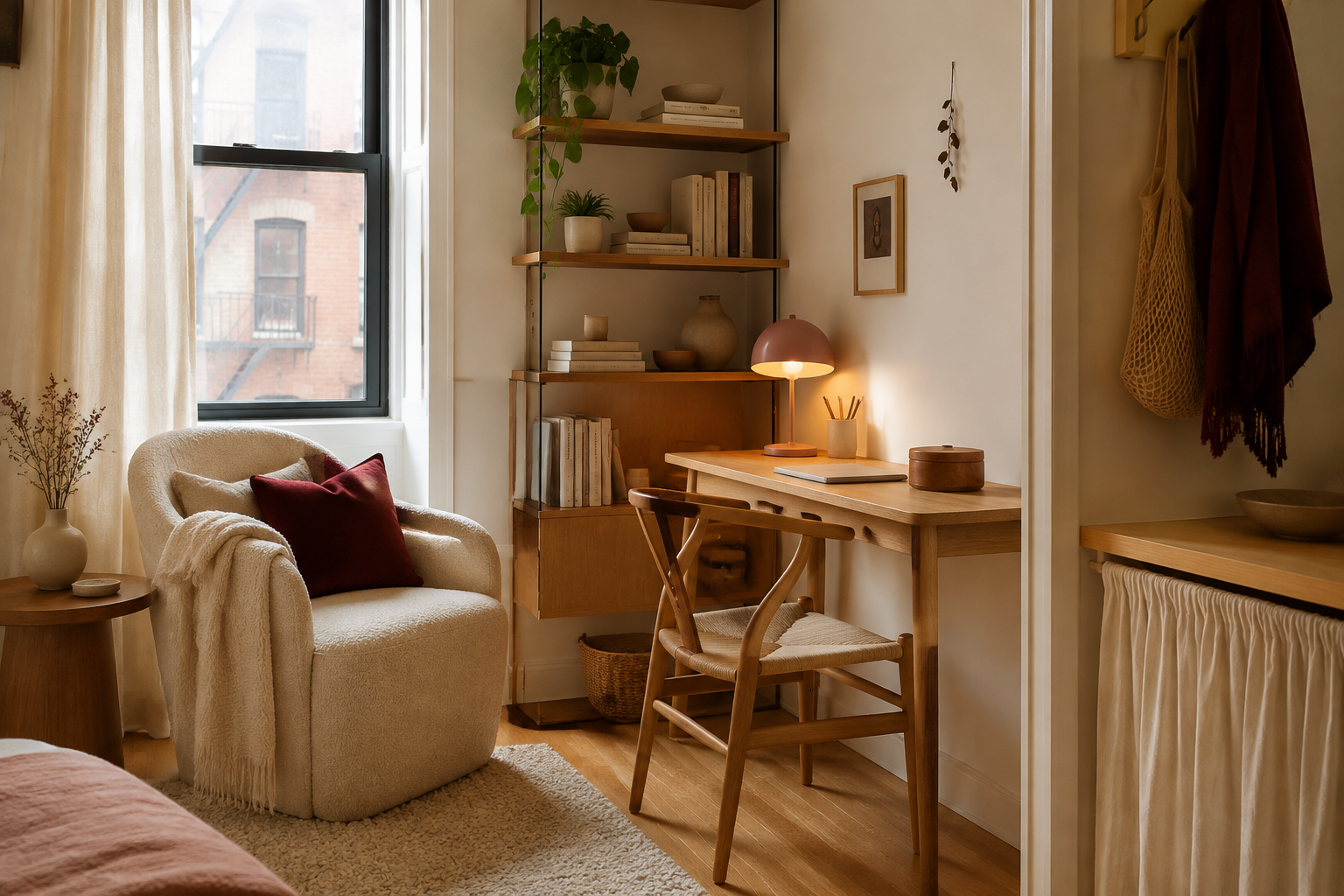
Pinterest’s 2026 Spring Trend Report noted rising searches for comfortable reading chairs in small spaces. You do not need a spare room to answer that desire. A corner with a chair, a light and somewhere to put a mug can become a genuine retreat. If you need a workspace more urgently, a narrow desk and wall shelf can use the same footprint.
The trick is not to ask the corner to do everything at once. A reading nook does not need a complete library. A desk does not need every office supply on display. Keep the item that supports the activity within reach and move the rest into closed storage. The zone will feel intentional even when the room around it serves several purposes.
Look up before buying another cabinet
Vertical storage is one of the few small-space ideas that consistently gives more than it takes. IKEA’s current small-space guidance also emphasizes using wall and shelving space when floor area is limited. A tall bookcase uses the same footprint as a low one while carrying far more. A shelf above a desk can hold the things that otherwise crowd the work surface.
Still, a wall packed from edge to edge can feel heavier than a piece of floor furniture. Mix open and closed storage. Keep a few loved objects visible and let doors, boxes or baskets hide the practical pieces. Negative space is part of the arrangement; it allows the objects you chose to be seen.
Change the feeling before you spend money
- Clear the walking path.
Move anything that makes you hesitate or turn sideways.
- Choose one focal point.
Let the bed, sofa, window or reading corner become the place the eye rests.
- Move a lamp.
Put light beside the activity instead of in an empty corner.
- Remove five tiny objects.
Keep the pieces that mean something and let them have room around them.
- Repeat one color.
Carry a shade from the largest textile into one smaller detail across the room.
- Shop your own home.
A basket, stool, mirror or framed print may solve the problem in a better room.
Mirrors help most when they reflect something worth seeing
A mirror is not magic simply because a room is small. Place it where it can catch daylight, a lamp or a calm part of the room. If it reflects a pile of laundry or the busiest shelf, it doubles the clutter too. A leaning mirror can be useful when wall mounting is impossible, but secure it appropriately if children or pets share the home.
Spend in the order that changes daily life
Start free: edit, move and repurpose. Then spend on light and touch—the bulb that makes evenings gentler, curtains that soften the window, bedding that feels good against your skin. Buy storage only after you know exactly what it must hold. Otherwise, storage becomes another object demanding space.
If you want to bring in pink, choose it where you already need something. Replace the worn bath mat with a muted rose one. Choose a blush desk lamp because the corner needs light. Add a burgundy cushion because the sofa needs support. The color becomes part of a solution, not an obligation to buy.
The things that make a room feel smaller
Too many miniature pieces can be less effective than one properly scaled chair or lamp. Furniture pushed against every wall can leave a useless patch in the center while making the edges look busy. A rug that barely reaches the coffee table can visually shrink the seating area. One harsh ceiling light flattens every texture you carefully chose.
The answer is not perfection or a home that looks untouched. A blanket can be on the sofa. Books can wait beside the bed. Your shoes may be by the door because you actually live there. The goal is to give everyday life a place to land so it does not feel like evidence that you failed to keep up.
A beautiful home is not a reward for becoming richer, tidier, thinner or more impressive. It is one way of telling yourself: I am here, and I matter.
Small can still feel like a little kingdom
That may be what people are really saving when Apartment Rooms rise on Pinterest. Not another clever container, but the possibility that the home they have now can feel warm and complete. A rental can hold history. A studio can hold glamour. One room can be practical in the morning and forgiving at night.
You do not need the approved version of femininity, a designer budget or a body that belongs in somebody else’s mood board. Your home can be soft because you need softness. It can be dramatic because ordinary never made you feel fully awake. It can be pink because pink makes you happy.
Begin with the corner you see first when you come home. Clear it, light it and give it one thing you love. That is enough for today. A sanctuary is not bought all at once. It is built through small decisions that keep saying the same thing: you deserve to feel at home here.